
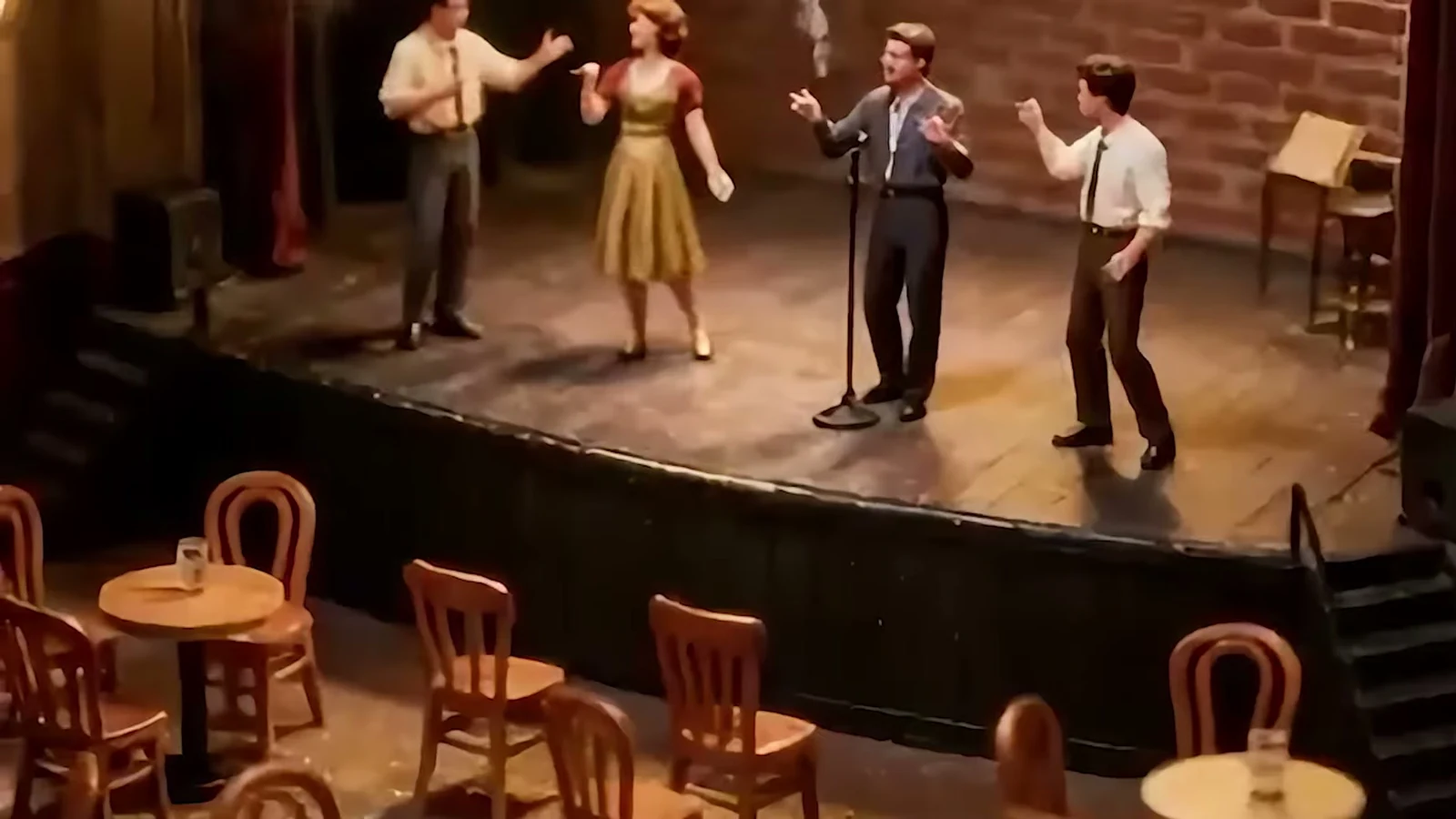
Improvisation has a reputation problem. Most people meet it as a party trick — a quick game on a stage, four people saying yes, and, and a punchline. The real story is stranger and far more useful: it runs from a psychiatrist's consulting room in 1920s Vienna, through a Chicago teacher who invented theatre games so that immigrant children could speak up, into a bar on Chicago's North Side where those games became modern comedy — and then, improbably, into training rooms full of people who never wanted to perform.
Six minutes of animated miniatures is the fastest way to see the whole arc. It is told for laughs, and it takes a few cheerful liberties with the tone of the history — but the spine of it is real:
Vienna, first: a psychiatrist puts problems on a stage
In 1920s Vienna, a psychiatrist named Jacob Moreno tried something that sounded absurd at the time: instead of only talking about a problem, his patients acted it out. He called the method psychodrama, and one technique from it outlived all the rest — role reversal. Switch places with the other person, speak as them, feel their side of the room. Every improv class still runs a version of it, because you do not get to stay inside your own head when you have to be somebody else. Moreno was working in a clinic; what we do is not clinical work, and we are careful about that line further down.
Chicago: theatre games become a craft
Viola Spolin, a teacher working with immigrant children in Chicago, built a system of theatre games — each one a rule, a problem, and no script. Children who would not speak up in class would play. Her son, Paul Sills, carried those games into the Compass Players in 1955, and out of that room came The Second City in 1959 and, in a straight line from it, a great deal of the comedy you have ever quoted. Mike Nichols and Elaine May were there early. The games were never really about being funny. They were about paying attention, out loud, with other people.
Two dialects: short form and long form
Improvisation split early into two families. Short form is quick and bright — a game, a suggestion from the audience, a laugh. Pop music. Long form is slower: a whole story built from nothing, characters who get to keep their history, twenty-five-minute explorations. Jazz. Both are taught in our rooms. The useful part, for somebody who is not planning to be a comedian, is identical in both: you practise responding instead of rehearsing.
London: billed as workshops, because the censor was watching
In 1960s London, Keith Johnstone was running public improvisation experiments at the Royal Court and pushing collaborative storytelling further than anyone had. Performing without a script in public was a grey area, so the shows were billed as workshops. His book Impro (1979) is still the standard text. One exercise from it is the simplest empathy machine there is: build a story one word at a time. You cannot plan your sentence, because you do not know what the last word will be — so you have to listen to the person who is speaking. Nothing has improved on that.
Then the clinicians started comparing notes
By the early 2000s, the people teaching improv and the people studying social anxiety had begun comparing notes, and in 2002 they founded the Applied Improvisation Network. That is the point where theatre games stopped being a stage trick and became applied improvisation.
The research is real, and narrower than the jokes. A ten-week, school-based improv programme with 268 teenagers in Detroit, published in The Arts in Psychotherapy (Felsman, Seifert & Himle, 2019, volume 63, pages 111-117), found that the students who screened positive for social phobia reported reduced social anxiety afterwards, alongside better social skills, more hope, and a greater willingness to make mistakes. The authors describe school improv as an accessible, non-clinical alternative, and the students who engaged most got the most out of it.
What that is not: a treatment. Improv may support confidence, connection and communication. It is not a substitute for clinical therapy, and our classes are classes, not clinical care. We are deliberately careful about this line, because the honest version of the claim is strong enough on its own.
And then the boardrooms noticed
Corporations found the same exercises and bought them as professional development — first as a novelty, then seriously. The skills that turn out to matter in a meeting are exactly the ones the games build: listening to the sentence someone actually said, accepting an offer instead of arguing with it, and staying in the room when the plan falls apart. Remote work and AI have polished up everybody's writing while hollowing out the same people's ability to read a room. The improvised skills got more valuable, not less.
What that looks like in one of our rooms
Railway City Improv has run in-person classes and workshops since 2018 — in London, St. Thomas, Union and across Southwestern Ontario. Classes are closed, nothing is recorded, and there is no performance at the end. Nobody will make you be funny. You will be put in the same moment as the other people in the room, over and over, until your attention stops living in your head.
Performance optional. The skills are not. If you would rather do this than read about it, the class list on this site is the place to start — and the people in the room are also not comedians.