
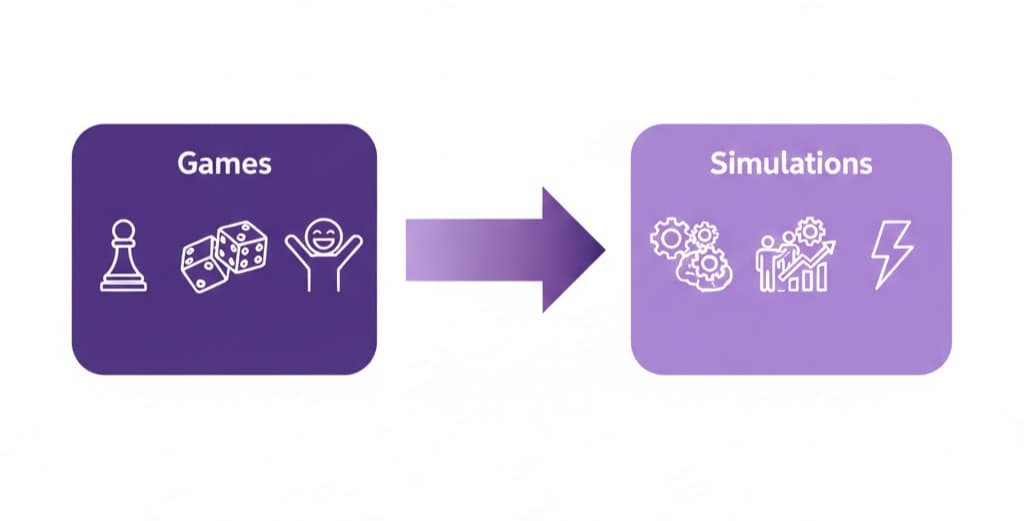
In today's fast-paced, unpredictable world, businesses and individuals alike are constantly seeking methods to improve adaptability, problem-solving, and leadership under pressure. Yet, when confronted with the idea of "improv games," many executives and professionals roll their eyes. They perceive them as frivolous, time-wasting activities disconnected from the serious demands of their roles. This perception is precisely why we've reframed our approach: we don't play "games"; we run "Real-World Simulations."
The difference is profound and deliberate. While traditional improv often uses games to build foundational skills, the critical step is the application of those skills to tangible, high-stakes scenarios. Our "simulations" are meticulously designed to mimic the complex, ambiguous, and often urgent situations that professionals face daily. These aren't about being silly; they're about building the muscle memory for critical business functions: navigating difficult conversations, innovating under tight deadlines, leading through uncertainty, and pivoting strategy on the fly.
Imagine a "simulation" where your team must collectively brainstorm and present a solution to an unexpected supply chain disruption, with new information constantly introduced and constraints changing. Or a "simulation" where you practice delivering tough feedback, handling client objections, or de-escalating a tense workplace conflict – all within a safe, controlled environment where the stakes are simulated, but the learning is very real. This type of experiential training goes far beyond theoretical knowledge; it imprints the skills directly into your "human operating system."
In a world increasingly reliant on automated processes, the demand for human ingenuity, empathy, and adaptive leadership has never been greater. Our "simulations" provide a unique training ground for these indispensable qualities. They're designed to cultivate the kind of spontaneous collaboration, clear communication, and resilient mindset that drives real-world impact and tangible results. This isn't about an afternoon off; it's about investing in the adaptive intelligence that will define success for individuals and organizations in the years to come. Stop playing games with your potential; engage in simulations that prepare you for success.
<footer class="PhCafd B6ltWa"